
Hard water is common across much of Ireland. Roughly half of the Republic sits on limestone rock. The midlands and much of the east and south tend to be hardest. The west and the granite uplands are usually softer. County alone will not tell you. The quickest way to find out is a hard water test at home. A test strip gives you a calcium carbonate reading in under a minute.
Two homes twenty minutes apart can have completely different water. One kettle furs up within a month. The other stays clear for a year. Same weather, same rain, same country.
The difference is what the rain travelled through before it reached the tap.
What makes water hard in the first place?
Rain arrives almost mineral free. It picks up calcium and magnesium as it moves down through soil and rock. The rock is what matters. Limestone is mostly calcium carbonate. Rainwater is slightly acidic, so it dissolves that rock easily. Granite, quartzite and older hard rock give up very little.
That single fact explains most of the pattern across Ireland.
Geological Survey Ireland reports that around 40 percent of the island sits on limestone. For the Republic alone the figure is about 50 percent. It is the main rock across the central lowlands. GSI also notes that Dublin and Limerick sit on karst limestone, as do large parts of Galway and Cork cities.
So hard water in Ireland is not an odd local problem. For a very large share of homes it is simply what comes out of the tap.
Which parts of Ireland tend to have the hardest water?
I want to be careful here. A tidy county map would mislead you. Hardness follows the rock and the source, and neither one stops at a county line.
What the geology does support is a broad pattern.
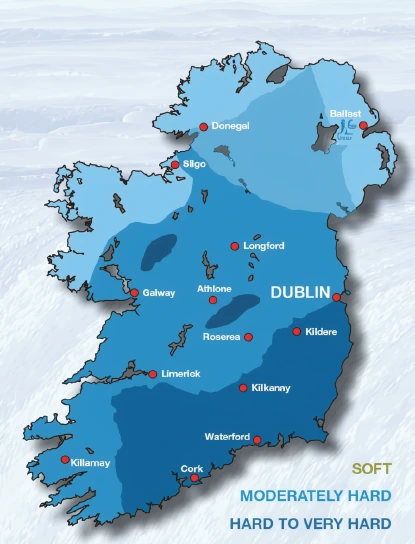
Usually harder. The central limestone lowlands, taking in much of the midlands, and large parts of Leinster and inland Munster. Groundwater here has long contact with limestone, so it tends to carry the highest mineral load.
Usually softer. Upland and western areas built on granite and quartzite. Parts of Donegal, Connemara, Wicklow and the Kerry mountains fall into this group. Water from peaty upland reservoirs is usually soft.
Truly mixed. Cities and large towns fed from more than one source. Dublin is the clearest case. Parts of the city and county draw from different plants, and the hardness differs a lot between them.
That last point is worth holding onto. Neighbours on the same road normally share a supply. Two estates a few kilometres apart may not.
How can I test my water at home?
You do not need a lab, and you do not need to wait for anyone. You can get a useful reading at your own kitchen tap in about a minute.
How a hard water test works
The method is called a titration, and it is the same principle labs use. You add a measured reagent to a water sample until a reaction finishes, then count how much you needed.
The reagent contains a compound that binds to calcium and magnesium, the two minerals that make water hard. It also carries an indicator dye. While free hardness minerals are still in the sample, the dye holds the water red. Once every last one has been bound up, nothing is left for the dye to cling to, and the sample turns blue.
That colour change is the endpoint. The number of drops it took to reach it is a direct measure of how much hardness was in your water. More minerals means more drops.
This is why a reagent test tells you more than guesswork ever will. It is measuring the exact thing that forms limescale, rather than a general impression of your water.
How to run the test
Our hard water reagent comes with a sample bottle, so you have everything you need in one box.
Run the cold tap for about thirty seconds first. This clears any water that has been sitting in the pipe overnight, which can read higher than your true supply.
Fill the sample bottle to the twenty millilitre line. Getting this right matters, because the drop count is calibrated to that exact volume. Over fill it and your reading will come out low.
Add the reagent one drop at a time. Swirl the bottle gently after every single drop and watch the colour. Hold it against a white background or a bright window so the change is easy to see.
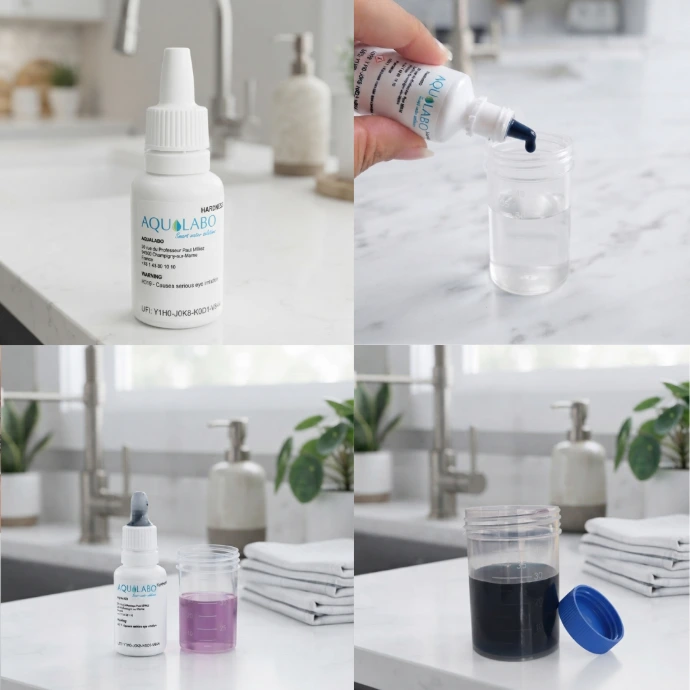
Keep counting until the sample turns from red to blue. Stop at the first proper colour change and write the number down.
Reading your result
Your drop count converts to a hardness figure using the scale printed with the reagent. That gives you a number you can compare against the classification bands below.
Here is how your drop count maps onto the classification bands.
Hardness level | Drops of reagent | mg/L CaCO3 |
|---|---|---|
Very soft | 0 to 8 | 0 to 80 |
Soft | 8 to 15 | 80 to 150 |
Moderately hard | 15 to 25 | 150 to 250 |
Hard | 25 to 35 | 250 to 350 |
Very or extremely hard | Over 35 | Over 350 |
If your count is low, your water is soft and scale is unlikely to trouble you. A high count means your water is carrying a heavy load of calcium and magnesium, and limescale is already forming wherever you heat water.
Two checks that cost nothing
Fill a clear bottle halfway with tap water. Add a few drops of pure liquid soap, cap it, then shake hard. Soft water throws up a good head of bubbles. Hard water gives a thin cloudy layer and little foam.
Then look at your kettle element. It is still the most honest gauge in any home.
If you are on a private well, testing matters even more. Wells in limestone areas are often harder than nearby public supplies. Groundwater has more contact with rock than surface water does.
At what point is treatment actually worth it?
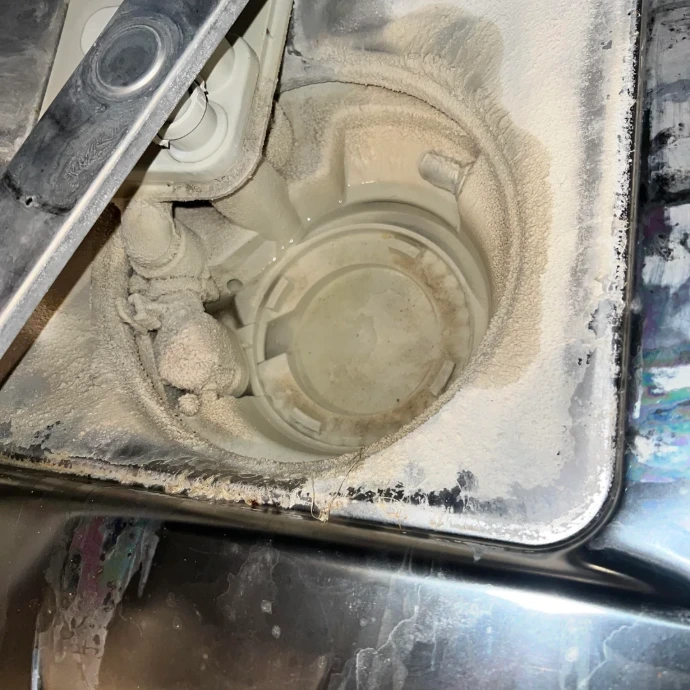
Scale builds up over time. It forms fastest where water is heated, so the immersion, the boiler and the heating parts inside appliances take the load first.
A layer of scale on a heating element acts like a blanket. The element runs longer and hotter to reach the same heat. That raises energy use and shortens the life of the appliance. Inside pipes and shower heads, scale narrows the opening. Flow drops away slowly enough that most people never notice.
As a rough guide, a moderately hard reading means regular descaling and more cleaning products. A hard or very hard reading means the cost has moved from cleaning into energy and equipment.
To work out what size unit a home like yours would need, our water softener sizing guide sets out the sums.
What to do if your supply comes back hard
Test first. Everything else follows from the number.
Say your test comes back hard or very hard. Only one approach stops scale forming. You take the calcium and magnesium out before the water enters your pipes. Descalers treat what has already happened. A softener changes what arrives.
The Classic Water Softener fits to the rising mains, so every outlet in the house gets treated water. It takes out the hardness minerals behind limescale and recharges itself with very little upkeep. Fitting is included across Ireland and Northern Ireland.
Renewell Water is Ireland's Number 1 rated water filtration company, with thousands of reviews from households nationwide. You can read them at renewellwater.com/reviews.
Test your own tap before you do anything else. A minute with a meter and a strip settles the question for good.
Renewell Water offers a free consultation for you. Book it by clicking here.